How AI Helps Students Master JEE Chemistry: 2026 Guide
Key Takeaways:
- AI in JEE Chemistry has demonstrated a 30–40% score improvement for students using adaptive platforms.
- Chemistry contributes to ~33% of your JEE score — and AI can be your unfair advantage in all three branches.
- Over 86% of students already use AI tools for summarization and formula sheets.
- IIT graduates in AI/Tech roles are commanding packages as high as ₹2.5 Crore — making STEM + AI literacy a life-changing combination.
- IBRAIN students in Odisha are leveraging these exact tools to compete with top coaching centers nationally.
1. Introduction: The AI Revolution in JEE Preparation
The year is 2026. Over 13 lakh students will appear for JEE Main. The competition is fiercer than ever. And yet, a quiet revolution is happening in the study rooms of Class 11 and Class 12 students across India — a revolution powered by AI in JEE Chemistry.
What once required expensive coaching, thick reference books, and hours of rote memorization can now be broken down, visualized, personalized, and mastered using intelligent AI-powered tools. From understanding the SN2 reaction mechanism in 3D to solving Raoult's Law problems step-by-step, AI is not a shortcut — it is a smarter path to the same destination.
This guide is designed for serious JEE aspirants in Class 11 and 12 who want to understand exactly how artificial intelligence can strengthen their Chemistry preparation, improve their rank, and open doors to some of India's highest-paying careers. Whether you're from Bhubaneswar, Cuttack, or any town in Odisha — this 2026 guide gives you the tools the toppers are already using.
💡 Stat to remember: According to HeliumLearn, students using AI-guided study plans improved their scores by 30–40% within months of consistent usage.
2. Why Chemistry Is the 'Rank Decider' and How AI in JEE Chemistry Changes Everything
Ask any IIT qualifier, and they'll tell you the same thing: Chemistry is where ranks are won or lost. Here's why.
In JEE Main 2025, Chemistry had 30 questions out of 90, contributing to one-third of your total score. Yet it is the subject where most students drop marks — not because they lack intelligence, but because of poor visualization (Organic), information overload (Inorganic), and weak mathematical foundations (Physical).
AI tools directly address each of these three pain points:
| **Chemistry Branch** | **Core Challenge** | **How AI Solves It** |
|---|---|---|
| **Organic Chemistry** | Abstract reaction mechanisms, 3D structures | Visual simulations, mechanism walkthroughs |
| **Inorganic Chemistry** | Vast data: properties, trends, salt analysis | Flashcard AI, smart Q&A, pattern recognition |
| **Physical Chemistry** | Complex numerical problems, formula application | Step-by-step solvers, adaptive practice sets |
Unlike a one-size-fits-all textbook, AI adapts to your specific weaknesses. If you consistently get Electrochemistry problems wrong, platforms like Embibe detect this pattern and flood your practice queue with targeted questions from that topic — until you've truly mastered it.
The result? Efficient preparation, not just harder preparation.
3. Visualizing the Abstract: AI in Organic Chemistry Mechanisms
Organic Chemistry is the bane of many JEE aspirants. Why? Because it demands spatial thinking — the ability to visualize electron movements, bond polarities, and molecular geometries in your mind. Traditional 2D diagrams on a blackboard rarely cut it.
This is where AI becomes genuinely transformative.
How AI Makes Organic Chemistry Visual
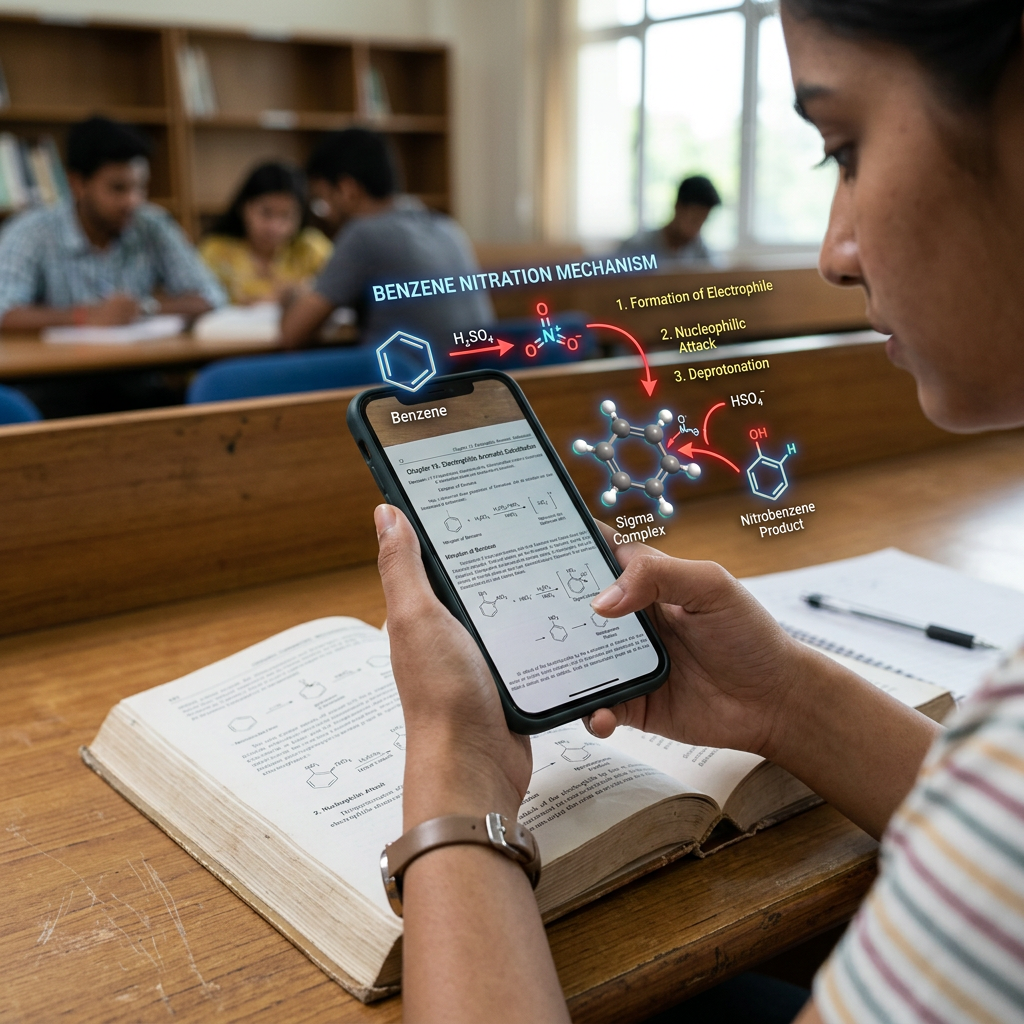
- 3D Molecular Modeling: AI-powered tools can render molecules like benzene, cyclohexane, and peptide chains in interactive 3D. You can rotate, zoom, and explore electron density maps — skills that directly improve your understanding of electrophilic aromatic substitution.
- Mechanism Animation: Platforms like Infinity Learn (AINA) use animated reaction pathways to show how electrons flow during nucleophilic additions, eliminations, and rearrangements — replacing memorization with understanding.
- NLP-Based Doubt Clearing: Simply type "explain why Markovnikov's rule works for HBr addition to propene" and AI gives a contextual, step-by-step explanation — not a generic definition.
- Error-Specific Feedback: When you incorrectly draw a mechanism, AI tools identify exactly where your logic broke down — whether it was a wrong leaving group identification or a missed resonance structure.
Organic Chemistry Topics AI Helps Most
- Named Reactions: Aldol Condensation, Cannizzaro, Wurtz, Kolbe — AI generates mnemonics, comparison charts, and quick revision sheets tailored to JEE Advanced patterns.
- Isomerism: Optical and geometrical isomerism visualizations are notoriously difficult to grasp from static images. AI renders these dynamically.
- GOC (General Organic Chemistry): Inductive effect, mesomeric effect, and hyperconjugation — AI breaks these down with real JEE questions mapped to each concept.
📌 Pro Tip: Use AI to generate "concept cards" for each named reaction with: reactant → product → conditions → JEE frequency. You'll cover 80% of asked reactions in 20% of the time.
4. Mastering Inorganic Chemistry: AI for Salt Analysis and Periodic Trends
Inorganic Chemistry is often dismissed as "pure memorization." That's a dangerous myth. JEE Advanced 2026 is expected to test deeper conceptual connections — why certain compounds form, why solubility follows specific trends, and how to identify unknown salts through systematic analysis.
AI doesn't just help you remember — it helps you connect.
AI-Powered Salt Analysis (Qualitative Analysis)
Inorganic salt analysis AI tools can:
- Simulate wet lab conditions digitally, walking you through flame tests, precipitation reactions, and gas evolution tests
- Present flowchart-style decision trees: "If the solution turns blue with litmus AND gives white precipitate with AgNO₃, it indicates..."
- Generate mock salt analysis problems calibrated to JEE Advanced difficulty levels
- Provide instant feedback when you choose the wrong reagent in a simulated analysis
This is especially powerful for students in Class 12 who are simultaneously preparing for board practical exams AND JEE — AI streamlines both.
Periodic Trends: Pattern Recognition with AI
| **Property** | **Trend Across Period** | **Trend Down Group** | **JEE Trick AI Teaches** |
|---|---|---|---|
| **Atomic Radius** | Decreases → | Increases ↓ | Anomalies: Li/Na, Be/Mg |
| **Ionization Energy** | Increases → | Decreases ↓ | Group 2 > Group 13 exception |
| **Electronegativity** | Increases → | Decreases ↓ | F is always the highest |
| **Electron Affinity** | Generally increases → | Decreases ↓ | Cl > F anomaly |
| **Metallic Character** | Decreases → | Increases ↓ | Key for reactivity series |
AI platforms generate comparative quizzes based on these exact trends — and when you answer incorrectly, they immediately explain why the exception exists (using atomic structure logic, not brute force memorization).
D-Block and F-Block Elements, coordination chemistry, and IUPAC nomenclature are areas where CogniGuide AI provides structured, adaptive question sets that mirror JEE Advanced patterns with uncanny accuracy.
5. Solving the Math: AI Tools for Physical Chemistry Problems
If Organic is about visualization and Inorganic is about patterns, Physical Chemistry is pure problem-solving. And problem-solving is where AI shines brightest.
Where Students Struggle Most in Physical Chemistry
- Thermodynamics: Applying Hess's Law, calculating ΔG, ΔH, ΔS in multi-step reactions
- Chemical Equilibrium: ICE table setups, Le Chatelier's principle applications
- Electrochemistry: Nernst equation, cell potential calculations, electrolysis stoichiometry
- Chemical Kinetics: First-order vs. second-order reactions, half-life calculations
- Solutions: Colligative properties, Raoult's Law deviations
How AI Becomes Your Physical Chemistry Problem Solver
Step-by-step solvers don't just give you the answer — they show every logical step, the formula used, the unit conversion, and the reasoning. This is like having a personal IIT-qualified tutor available at 2 AM the night before your exam.
🔢 Example Workflow: A student inputs a Nernst equation problem. The AI:
- Identifies the cell reaction
- Calculates standard cell potential from given E° values
- Applies Nernst equation with correct substitution
- Flags common errors (forgetting to divide by 'n')
- Suggests 3 similar practice problems at progressive difficulty
Embibe's AI engine does exactly this — and additionally tags each solved question with the JEE chapter, topic, subtopic, and historical frequency of appearance, so you always know how much a concept is worth your time.
6. Top AI Tools for JEE Chemistry in 2026
Not all AI tools are created equal. Here's a research-backed comparison of the best tools available to Indian JEE aspirants:
| **Tool** | **Best For** | **Unique Feature** | **Free/Paid** |
|---|---|---|---|
| **[Embibe](https://www.embibe.com/)** | Full JEE prep (all subjects) | Error analysis + performance DNA | Freemium |
| **[Infinity Learn (AINA)](https://infinitylearn.com/)** | Concept videos + doubt solving | AI-powered "why wrong" feedback | Freemium |
| **[CogniGuide AI](https://cogniguide.com/)** | Personalized study plans | Adaptive topic sequencing | Freemium |
| **Google Gemini** | Instant doubt clearing, concept explanation | Multimodal — accepts image-based questions | Free |
| **HeliumLearn** | Score improvement analytics | Tracks 30-40% improvement pattern | Paid |
| **Khan Academy (Khanmigo)** | Foundation building, Class 11 concepts | Socratic method AI tutoring | Free |
IBRAIN Tip: Use Embibe for analytics-driven practice, Gemini for instant doubt resolution, and CogniGuide for personalized revision schedules. This three-tool stack covers 95% of your AI-powered study needs.
7. Adaptive Learning: Personalized Study Plans for Class 11–12
One of the most powerful applications of AI in education is adaptive learning — the ability of a system to change what it teaches you based on how well you're currently performing.
Traditional coaching gives every student the same schedule. IIT JEE adaptive learning gives every student a different schedule — one built around their unique strength-weakness profile.
How Adaptive Learning Works in JEE Chemistry
- Diagnostic Assessment: You take a 30-minute test. AI maps your current performance across all Chemistry topics.
- Priority Matrix Generation: Topics are ranked by: (your weakness) × (JEE frequency) × (time to master)
- Dynamic Daily Plans: Your study plan updates every 48–72 hours based on your practice performance.
- Spaced Repetition Scheduling: Topics you learned 10 days ago are automatically re-queued before you forget them (using the Ebbinghaus Forgetting Curve).
- Mock Test Calibration: Your mock tests are generated based on your weak topics — not generic sample papers.
According to the Digital Education Council, 86% of students are already using AI for summarization and formula sheets. But only the top students use it for adaptive learning — which explains why the top 1% of JEE scorers are increasingly AI-literate.
📊 Class 11-12 JEE Study Tip: Start adaptive learning in Class 11 itself. Students who begin AI-assisted preparation early have a statistically proven advantage by the time JEE Advanced rolls around. Don't wait until dropper year to discover these tools.
8. Real Success Stories: How AI Boosted JEE Scores
Abstract advice is helpful. Real stories are motivating.
From Odisha to IIT: The AI Advantage
Across India, students from Tier 2 and Tier 3 cities are increasingly closing the gap with students from metropolitan coaching hubs — thanks to AI platforms. Students who previously couldn't access quality mentorship in Odisha are now using the same tools as students attending premium coaching in Kota or Delhi.
Key documented outcomes from HeliumLearn's case studies:
- Students using AI-guided revision plans showed 30–40% score improvement in Chemistry specifically within 3–4 months of consistent use
- Time spent on non-exam-relevant content dropped by over 40% after AI prioritization
- Students reported reduced exam anxiety because AI-driven mock tests eliminated "surprise" question formats
The IBRAIN Model
At IBRAIN, Odisha's #1 IT Academy, students are guided to integrate AI tools alongside structured mentorship — not as a replacement. This hybrid model — human expertise + machine precision — consistently produces students who are technically grounded AND strategically prepared for JEE 2026.
9. Beyond the Exam: AI Skills and Future IIT Salary Packages
Here's the big picture that every Class 11–12 student must understand: why you're doing this.
The IIT Placement Reality in 2026
The IIT dream isn't just about the degree — it's about what you do with it. And the data is sending a clear signal:
- IIT Bombay's 2026 Placements saw a highest domestic package of ₹1.48 Crore+ and an international package of ₹2.2 Crore
- A student from IIT Hyderabad secured ₹2.5 Crore in 2025–26 — the highest ever at that institution — in an AI/Tech role
- However, IIT median salaries dropped 15–31% at several institutes in 2024–25, according to Careers360's NIRF analysis
- IIT placement rates for B.Tech dropped from ~90% to ~80% between 2022 and 2024, per Hindustan Times
⚠️ The Clear Message: A generic IIT degree no longer guarantees a top salary. AI skills + strong technical foundation = the new gold standard. The students getting ₹2.5 Crore packages are the ones who combined engineering fundamentals with AI literacy.
This means every hour you spend mastering JEE Chemistry using AI tools is doing double duty: preparing you for the exam AND building the AI fluency that top employers in 2026 and beyond are willing to pay ₹1 Crore+ for.
10. Challenges and Best Practices for Using AI Wisely
AI is a powerful tool — but like all tools, it can be misused. Here's what separates smart AI users from students who waste time:
Common Pitfalls
- Over-reliance on AI explanations without practicing on paper — JEE is still a pen-and-paper exam
- Using AI for answers instead of using AI to understand why the answer is what it is
- Tool-hopping — switching between 5 different apps without mastering any one
- Ignoring NCERT — AI supplements NCERT; it does not replace it for JEE Mains
Best Practices
| **Do This** ✅ | **Avoid This** ❌ |
|---|---|
| Use AI to understand concepts, then solve offline | Copying AI solutions without thinking |
| Set a timer for AI-assisted sessions | Spending 4 hours "studying" with AI passively |
| Use AI diagnostic tests weekly | Only using AI 2 weeks before the exam |
| Cross-reference AI explanations with NCERT | Treating AI output as 100% infallible |
| Let AI track your weak areas | Ignoring AI analytics and feedback |
🧠 Golden Rule: AI should make you think harder, not think less. The best use of AI in JEE prep is to ask it the right questions — and then verify, practice, and master on your own.
11. Conclusion: Integrating AI into Your Daily JEE Chemistry Routine
The future of AI in JEE Chemistry preparation is not coming — it is already here. Students who are reading this article in 2026 have access to tools that their predecessors could not have imagined: AI tutors that know their weak topics, adaptive engines that rebuild their study plans overnight, and visual simulations that make organic mechanisms as clear as a YouTube video.
But technology is only as powerful as the student wielding it.
Your roadmap is clear:
- Start with a diagnostic test on Embibe or CogniGuide — know exactly where you stand
- Use AI visualization daily for Organic Chemistry mechanisms — 15 minutes every day
- Drill Inorganic patterns with AI-generated flashcards and salt analysis simulators
- Solve Physical Chemistry numericals with step-by-step AI solvers — but write every step by hand
- Track your progress weekly — let AI show you the 30–40% improvement in real time
- Stay NCERT-anchored — especially for JEE Mains, where NCERT is still king
The students who will secure AIR under 1000 in JEE 2026 are not necessarily the most talented. They are the most strategically prepared. And with the right integration of AI tools and disciplined study, that student can be you.
At IBRAIN, Odisha's #1 IT Academy, we believe every student deserves access to world-class preparation tools — regardless of their city, background, or budget. The AI revolution is the great equalizer. Use it.
Sources
- IIT Bombay Placement Report 2026
- Times of India / IIT Hyderabad Placement News
- HeliumLearn AI Case Study
- Hindustan Times – IIT Placement Analysis
- Careers360 / NIRF Salary Data Analysis
- Embibe AI Learning Platform
- Infinity Learn – AINA Platform
- CogniGuide AI Study Planner
- Digital Education Council – Student AI Usage Data
Written by the IBRAIN Content Team | Odisha's #1 IT Academy | Empowering Students from Class 1 to Career